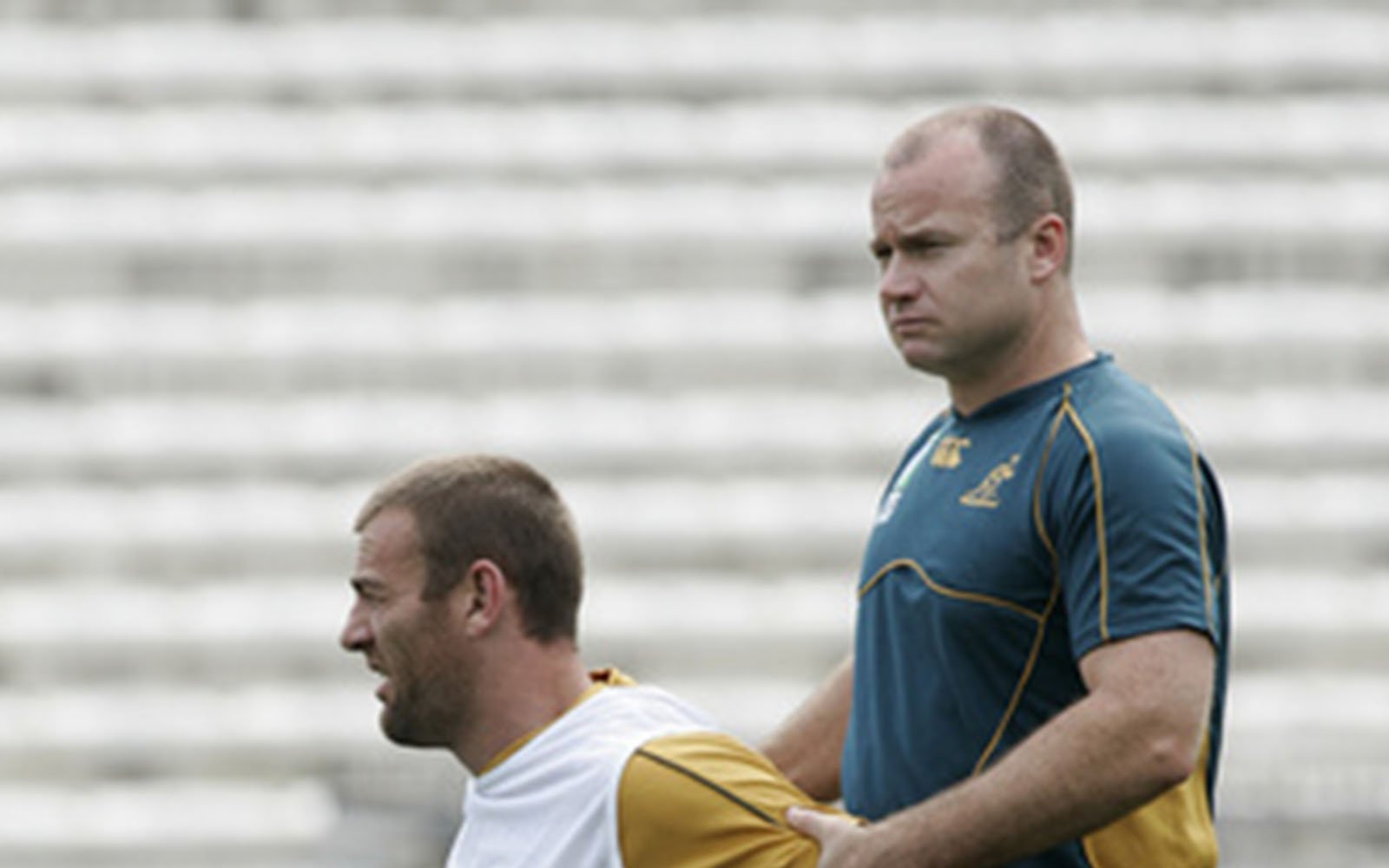

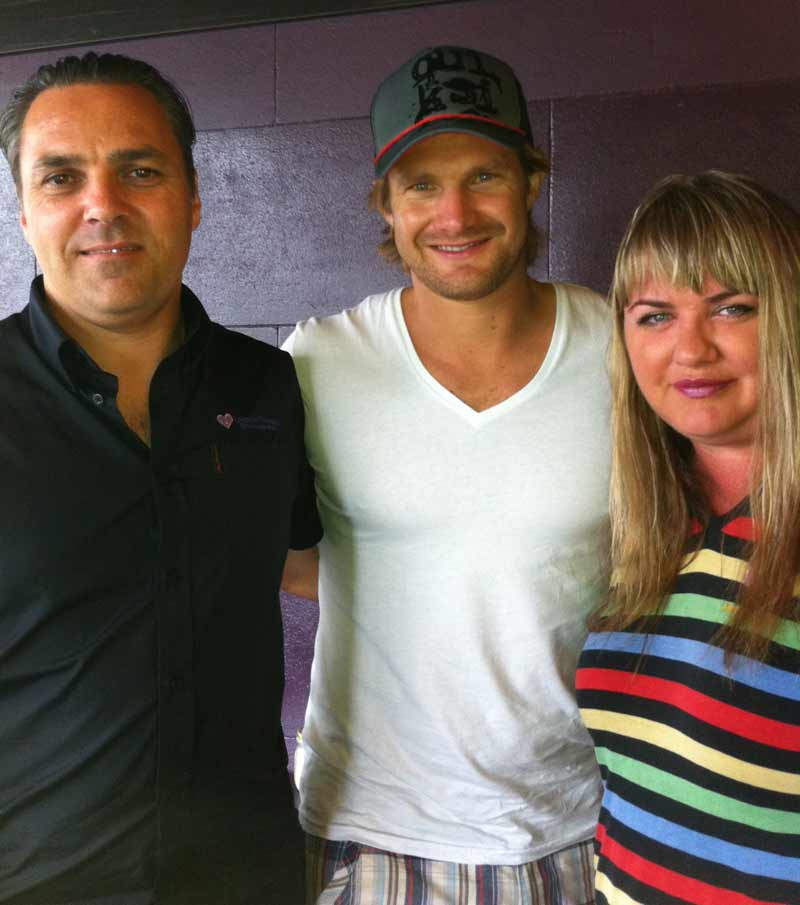
Shane Watson with Q Magnets inventors, James & Dianne Hermans
The Recovery Challenge in Elite Cricket
Elite cricket places unusual demands on the body. Players deal with repeated travel, long hours in transit, impact injuries, bruising, training load, and the pressure to keep performing while the body is still settling. In that setting, even a relatively local issue such as lower back discomfort or a deep bruise can affect movement, comfort, and preparation. The original Shane Watson page frames this in practical terms: lower back discomfort during long-haul flights, difficult injuries that were not responding well to usual treatment, and the day-to-day knocks that come with batting and field sport.
How Magnetic Therapy May Fit Cricket Recovery
In sport, magnetic therapy tends to make the most sense as a local adjunct used early and used well. The broader Q Magnets sports recovery page positions it around fresh soft-tissue injuries such as bruises, corks, strains, and minor sprains, especially when timing and placement are handled properly. It also frames the mechanism conservatively: static magnetic fields may influence processes relevant to recovery, including pain signalling, ion-channel behaviour, inflammatory activity, and local vascular responses, while not every injury responds in the same way. For readers who want a broader background explanation, see magnetic therapy and How Q Magnets Work.
How Shane Watson Used Q Magnets in Practice
According to the original page, Shane Watson had previously found Q Magnets helpful for low back pain during long-haul flights. The page also states that he was encouraged by sports physiotherapist Victor Popov to try Q Magnets as part of the effort to work through injuries that were not responding to normal treatment. When Q Magnets were delivered, the discussion also included practical use for bruising, reflecting the fact that cricket often involves impact injuries as well as strain-based problems.
This is where Field | Dose | Placement becomes useful in a cricket setting. The principle is simple: the field structure matters, the device size and exposure matter, and placement over the actual target tissue matters. For a travelling athlete with lower back discomfort, that points readers toward Field | Dose | Placement and the lower back pain treatment guide, where Q Magnets are placed over specific lower-back landmarks rather than used vaguely nearby. For a bruise or calf contusion, the same logic applies: use the right magnet for the size and depth of the tissue, then place it directly over the affected area as early as practical.
For acute knocks and soft-tissue injuries, the broader sports recovery guidance on the site suggests a practical pattern: apply the magnet as soon as possible, place it directly over the point of impact or irritation, and continue alongside standard care rather than instead of it. That makes this page less about a dramatic promise and more about a repeatable application pattern that fits how athletes actually manage recovery.
What This Case May Suggest for Athletes
The Shane Watson example is useful because it combines two very common sporting situations. The first is lower back discomfort linked with the realities of travel and ongoing load. The second is acute impact injury, where timing and practical placement may matter more than broad theory.
Seen in that light, this case suggests a pattern already reflected elsewhere on the site: athletes and practitioners tend to get the most from Q Magnets when they apply them early, place them directly over the target tissue, and use them as one part of a broader recovery routine. That same pattern appears across the sports recovery testimonials, which group examples ranging from bruises and corks to sprains, strains, shin soreness, and heavy training recovery.
Limits of a Single Athlete Case
A single athlete story is still a single athlete story. It may be useful as an observation, but it should not be treated as proof that every player, every injury, or every stage of recovery will respond the same way. Outcomes can vary depending on the type of tissue involved, how early the device is applied, whether the placement is accurate, and whether the problem is an acute sporting knock or a more complex pain presentation.
That is also why it helps to avoid overstating what magnets do. Q Magnets are better presented as a non-powered, local adjunct that may support comfort and recovery in some settings, not as a replacement for diagnosis, rehab, load management, or medical care when those are needed. The site’s lower back page also makes that point clearly by stating that Q Magnets are not intended to replace medical treatment recommended by a health professional.
Apply Q Magnets directly over impact areas like bruises or lower back strain during travel or recovery sessions to maintain comfort and stay training-ready.
Next Steps for Sports Recovery and Lower Back Pain
If you are dealing with a fresh sports injury, recurring travel-related lower back discomfort, or a local impact injury from training or competition, the next step is usually not to overcomplicate things. Start with timing, device choice, and placement.
For the broader framework, begin with magnetic therapy for sports injury recovery. If the issue is more specifically lower back pain, review the lower back pain treatment guide. If you want to understand why some applications work better than others, read Field | Dose | Placement. And if you want to compare this case with others from sport, browse the sports recovery testimonials.
A sensible next step is to use Q Magnets as part of a broader recovery plan: identify the tissue involved, apply the right device early, place it accurately, and reassess honestly as the area settles. That keeps expectations realistic while still giving the method its best chance to be useful.
Shane Watson has always been a strategic thinker when it comes to leadership and sports performance.
See Shane’s excellent podcast series Lessens Learnt With the Greats here,
Frequently Asked Questions
1. How do Q Magnets work?
Q Magnets are designed to create localized static magnetic field gradients using multipolar magnet geometry. Unlike simple bipolar magnets, Q Magnets use alternating poles within one device to produce a more complex field pattern.
The proposed biological effect is not based simply on magnet strength. Instead, Q Magnets are positioned through Field | Dose | Placement:
Field: multipolar geometry and localized gradients.
Dose: magnet size, field strength, tissue depth, exposure time, and cumulative use.
Placement: accurate positioning over or near the relevant nerve, joint, soft tissue, acupressure point, or referral pathway.
Research and theoretical work suggest that steep static magnetic field gradients may influence neuronal membrane excitability and ion channel behaviour. This may help explain why correct placement and model selection are so important.
Q Magnets should therefore be understood as precision field-based recovery tools rather than general-purpose magnets.
2. How do I apply the Q Magnet device?
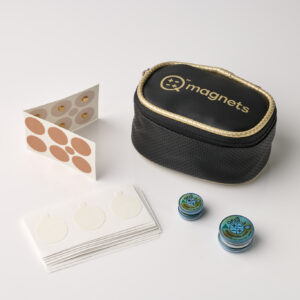
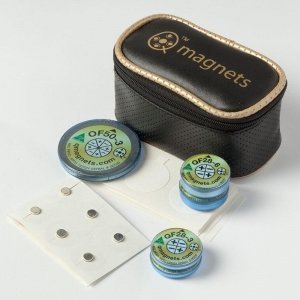
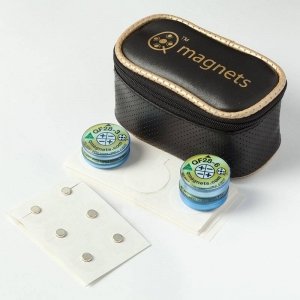
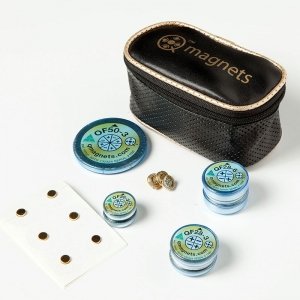
Q Magnets can be applied using sports tape such as Fixomull, Hyperfix, or Cover-Roll, double-sided adhesive patches such as QFix28, QFix6 plasters for smaller models, braces, elastic supports, bandages, headbands, or the Flux Attachment Plate for suitable clothing applications.
The key is to hold the magnet securely in the correct position. Q Magnets depend on accurate placement, and even a small shift may change the field exposure at the target area.
See How To Use Q Magnets.
For longer use, many people prefer a brace, wrap, elastic support, or clothing-based attachment method rather than repeated taping. For sport or movement, make sure the magnet cannot slip, detach, or attach unexpectedly to metal equipment.
Always apply the magnet with the correct side facing the body and the orientation arrow aligned as directed.
3. Since placement of Q Magnets is critical, how does one find the specific placement?
The simplest starting point is to place the Q Magnet over the area of tenderness. This may be suitable for local pain patterns such as a tender tendon, joint, muscle area, or minor localized injury.
However, placement is not always obvious. Pain may be referred from another area, influenced by nerve pathways, or related to spinal segments, acupressure points, or sensitized neural structures. In these cases, multiple Q Magnets may be used along relevant nerve pathways or related anatomical regions.
This is where Field | Dose | Placement becomes practical. The field must be appropriate for the target, the magnet size and exposure must match the depth and tissue, and the placement must be accurate enough to expose the intended area to the field gradient.
For example, a local sting or tennis elbow tenderness may respond best to direct placement over tender spots. A radiating nerve pattern may require placement closer to the relevant spinal level or nerve pathway. Acupressure-style placements may also be used in some protocols.
For most users, the Body Map is the best starting point because it gives recommended placements and magnet combinations. More complex pain syndromes may require guidance from a practitioner with knowledge of anatomy, neurology, physiotherapy, or acupuncture-style point selection.
4. Can I travel on planes while wearing Q Magnet devices?
Many people travel while wearing Q Magnets without issue. Wearing them through airport security usually does not cause a problem, but security rules and airline policies can vary.
The bigger concern is packing strong magnets in luggage. Some airlines or freight rules may restrict magnets in checked or carry-on baggage, particularly if they are strong or packaged poorly.
Keep Q Magnets securely packed so they cannot attach to metal objects, damage magnetic items, or move around in your bag. Check with your airline if you are travelling with multiple or larger magnets.
Do not use magnets in a way that could interfere with aircraft instruments, and always follow airline and airport instructions.