Fibromyalgia Pain Relief with Q Magnets: Janet’s Experience of Drug-Free Relief
Living with fibromyalgia often means learning to manage pain that can appear without warning. Many people experience recurring trigger points, muscular tenderness, fatigue, and stiffness that fluctuate from day to day. It is also common for fibromyalgia to occur alongside conditions such as osteoarthritis, creating additional challenges with movement and everyday activities.
This customer story follows Janet Rogers, who shares how she uses Q Magnets as part of her personal self-care routine to help manage recurring muscular discomfort. Her experience also provides an opportunity to explore how precision multipolar medical magnets and static field therapy are applied in practice.
As with all customer experiences, individual responses vary. Q Magnets are intended to provide localized temporary relief of minor aches and pains and should not replace appropriate medical assessment where needed.
Living with Fibromyalgia, Osteoarthritis and Painful Trigger Points
Janet, from St. Lucia in Queensland, Australia, describes living with both fibromyalgia and osteoarthritis.
She explains:
“I’m 70 and I have fibromyalgia and osteoarthritis so have lots of sore, tender spots that come and go, mainly in my lower back and shoulders. A bad trigger point can make life very difficult and hamper movement.”
Before using Q Magnets, Janet rated her pain at 7 out of 10.
She says:
“I’ve been a Q Magnets since the early days. My pain levels dropped to 1/10 after starting Q Magnets therapy.”
Although this reflects Janet’s personal experience, fibromyalgia affects everyone differently. Some people experience widespread discomfort, while others notice recurring areas of muscular tenderness known as trigger points that can interfere with sleep, movement, work, and daily activities.
Understanding Fibromyalgia and Trigger Points
Fibromyalgia is a complex condition that involves altered pain processing within the nervous system. Rather than being explained by tissue injury alone, modern pain science suggests that changes in nervous system sensitivity may contribute to persistent or fluctuating pain.
This is one reason why people living with fibromyalgia often report that symptoms can change location, vary in intensity, and respond differently to different forms of treatment.
Within the Q Magnets educational framework, static field therapy is viewed as a field-based recovery technology that may support recovery physiology through localized static magnetic field gradients. Research continues to investigate plausible mechanisms involving nervous system modulation and membrane excitability, although responses remain individual and are influenced by many factors.
How Janet Uses Q Magnets for Recurring Muscular Pain
Janet describes using Q Magnets whenever a painful trigger point develops.
She explains:
“When I get a painful trigger point, I just tape a Q Magnets device on it for a couple of days. This allows a painless mending of whatever caused the problem. Because I have fibromyalgia, I don’t expect a long-term fix, however I live painlessly most of the time.”
She also notes:
“Now I just need to use Q Magnets 3-4 times a month and wear them for an average of 3 days.”
Her experience reflects an important educational principle used throughout the Q Magnets system.
Responses to magnetic therapy are not determined by magnet strength alone. They may depend on several interacting factors, including the magnetic field design, the duration of application, and accurate anatomical placement.
Practical Insight: Why Field | Dose | Placement Matters
The Q Magnets application framework centres on Field | Dose | Placement (FDP).
Field considers the engineered multipolar magnetic field geometry and localized field gradients.
Dose includes factors such as magnet size, tissue depth, exposure duration, and cumulative wear time.
Placement focuses on positioning the magnet over the appropriate anatomical structures, because static magnetic fields decrease rapidly with distance.
Rather than asking whether magnetic therapy works in general, the FDP framework asks a more practical question:
Under what conditions might localized static magnetic field gradients support recovery physiology for a particular individual?
Magnet Placement and Products Used
When asked how she applies Q Magnets, Janet explains:
“I tape them over the sore spots and trigger points with Hypafix tape.”
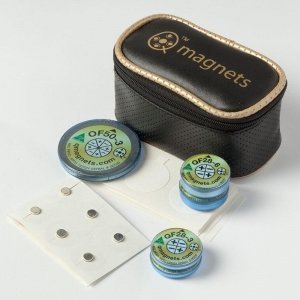
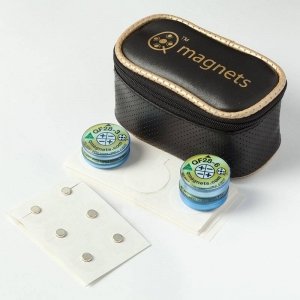
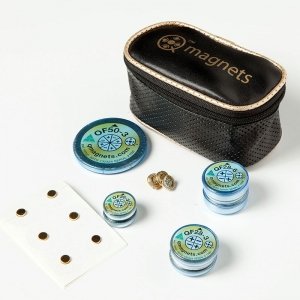
She uses the following products:
- OF15-2
- QF28-3
For episodes of sciatica she also describes using a larger magnet.
She explains:
“I also have a large magnet that I can use over my spine when sciatica is painful. It usually stops muscular pain below that part of my spine.”
Selecting the appropriate magnet depends on the anatomy being treated. Larger anatomical regions or deeper tissues may require different magnet sizes than smaller or more superficial areas. Practical placement guidance is provided within the relevant Q Magnets Treatment Protocols, which explain how Field, Dose, and Placement are applied to specific conditions.
Static Field Therapy and Precision Multipolar Medical Magnets
Many people searching for magnetic therapy are familiar with flexible magnetic products or magnetic bracelets. Q Magnets use a different approach.
They are precision multipolar medical magnets designed to create localized static magnetic field gradients rather than simply relying on overall magnetic strength. Their engineered polarity arrangements produce complex field geometries intended for therapeutic applications.
Current research has proposed several biologically plausible mechanisms that may contribute to observed effects. These include possible influences on membrane excitability, localized nerve signalling, and recovery physiology. While research continues to evolve, careful scientific communication recognises that these mechanisms remain areas of ongoing investigation rather than established clinical fact.
Why Drug-Free Pain Relief Matters to Janet
When asked what she likes most about using Q Magnets, Janet says:
“I like the fact that I can get instant drug-free relief for muscular problems. I cannot imagine what the quality of life would be without the magnets. I doubt if I could have continued to work without them.”
For many people living with chronic musculoskeletal conditions, finding non-pharmaceutical strategies that fit alongside everyday life is an important goal. Static field therapy represents one option that some individuals choose to incorporate into their broader recovery approach.
Q Magnets are wearable, reusable medical devices designed for prolonged passive application, allowing continuous localized exposure without external power sources. Their intended use is to provide temporary localized relief of minor aches and pains when applied appropriately.
Would Janet Recommend Q Magnets?
When asked whether she would recommend Q Magnets to friends and family, Janet’s response was simple.
Yes.
She also shared:
“I have fibromyalgia and QMagnets keep my sore and tender spots pain-free. I doubt if I could get out of bed if I had not found these years ago.”
Her experience reflects one person’s long-term use of Q Magnets as part of managing recurring fibromyalgia symptoms and muscular trigger points. While testimonials cannot predict individual outcomes, they provide valuable insight into how real users apply Q Magnets in everyday situations.
Key Takeaways
Fibromyalgia presents differently for every individual, and symptom severity can change over time. Janet’s story illustrates several practical principles that align with the Q Magnets educational approach:
- Recurring trigger points may require different applications at different times.
- Accurate Field, Dose, and Placement are important practical considerations.
- Precision multipolar medical magnets differ from generic magnetic products through their engineered field geometry and localized static magnetic field gradients.
- Static field therapy is best viewed as part of a broader recovery strategy rather than a standalone solution.
- If symptoms persist, worsen, or suggest an underlying medical condition, professional medical assessment remains essential.
For those exploring magnetic therapy for fibromyalgia, Janet’s experience provides a practical example of how Q Magnets can be incorporated into an ongoing self-care routine while recognising that every individual’s response and recovery journey is unique.