Jude’s Journey with Magnetic Therapy for Neck Pain, Lower Back Pain and Dizziness
Living with pain for years often means learning to adapt. Everyday activities such as gardening, walking, climbing stairs, or simply turning your head can gradually become more difficult. For many people, finding ways to support comfort and maintain an active lifestyle becomes an ongoing priority.
Jude Coursey from Christchurch, New Zealand, has experienced this journey firsthand. Following a childhood accident, she managed recurring neck pain and lower back pain for decades. More recently, she also experienced episodes of benign paroxysmal positional vertigo (BPPV), adding another challenge during a period when access to her usual healthcare support was limited.
Her experience illustrates how precision multipolar medical magnets can become part of an individual’s broader recovery strategy while complementing professional healthcare where appropriate.
A Childhood Injury with Long-Term Effects
Jude explains:
“I’m 68 and my health is good. I was a 13 year old doing a headstand when a boy decided he was going to pull my right arm out from me. I collapsed down from my head stand and spent three weeks in bed unable to move.”
The injury affected multiple areas of her body.
Over the years she continued to experience:
- recurring cervical neck pain
- lower back discomfort
- sacral pain
- hip instability
- tendon pain
- knee discomfort
She also continued seeing osteopaths as part of her ongoing care.
As she describes:
“My neck gets regular pain from the cervical. My vertebrae has been damaged from the fall as also lower back and sacral area.”
When Access to Treatment Became Difficult
Like many people during lockdown periods, Jude suddenly found herself unable to access her usual osteopathic treatment.
Around the same time she experienced BPPV, a condition that commonly causes brief episodes of dizziness triggered by changes in head position.
While BPPV has a number of recognised causes and is commonly managed through assessment and repositioning manoeuvres performed by appropriately trained healthcare professionals, people living with neck pain may also be looking for additional ways to support overall comfort during recovery.
Jude chose to incorporate Q Magnets into her personal management routine during this period.
She recalls:
“Recently because of my neck I have experienced BPPV and with the Lockdown unable to get osteopath treatment and successfully used the magnet for this.”
Individual experiences vary, and Q Magnets are intended as a non-invasive supportive option rather than a replacement for medical assessment or treatment.
Understanding Field | Dose | Placement
One of the principles behind Q Magnets is that application involves more than simply placing a magnet over an area of discomfort.
The Q Magnets educational framework emphasises three interacting variables:
Field
Precision multipolar medical magnets are designed with engineered polarity arrangements that create localized static magnetic field gradients rather than simple uniform magnetic fields.
Dose
Appropriate magnet size, exposure duration, tissue depth and cumulative wear time may all influence the overall field environment experienced by superficial tissues.
Placement
Accurate anatomical positioning matters. Correct placement aims to bring localized static magnetic field gradients closer to the tissues or sensitized structures being targeted. This is why Q Magnets provide condition-specific placement guidance rather than recommending identical placement for every person.
A Practical Recovery Routine
Rather than relying on a single application, Jude developed a routine that addressed several areas depending on her symptoms.
She explains:
“I use the Q Magnets a few days a week on the neck shoulder area, lower back sacral, fingers for tendon pain, knee, hip flexor and toes.”
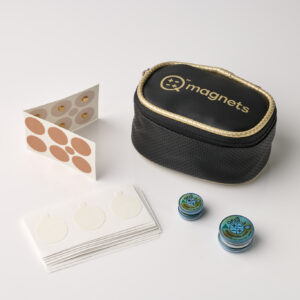
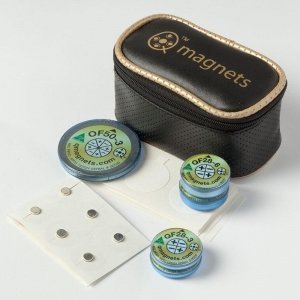
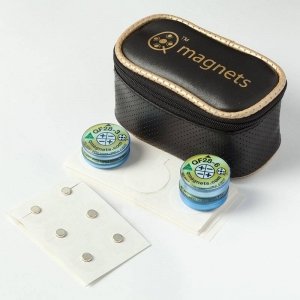
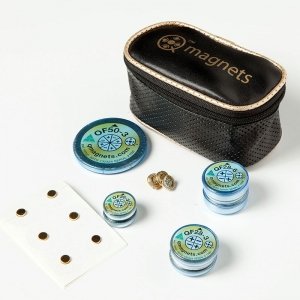
She also selected different Q Magnet models for different body regions:
This reflects an important principle of static field therapy. Different anatomical structures may benefit from different magnet sizes and field characteristics. Matching the field to the target tissue is part of the Q Magnets Field | Dose | Placement philosophy and recognises that anatomy, tissue depth and application goals all vary. Precision multipolar medical magnets are available in different sizes and configurations to support these practical considerations.
Supporting Recovery Through Static Field Therapy
Q Magnets are passive medical devices that generate localized static magnetic field environments using engineered multipolar magnetic configurations. Unlike technologies that actively deliver electrical or photonic energy, static field therapy establishes a persistent field environment while the device is worn.
Current scientific understanding proposes several biologically plausible mechanisms that may contribute to observed effects. These include interactions with localized static magnetic field gradients that may influence membrane excitability, nervous system regulation, or recovery physiology. Research in bioelectromagnetics continues to investigate these possibilities, and responses can vary between individuals.
For this reason, Q Magnets are positioned as a field-based recovery technology that may support comfort and rehabilitation rather than as a cure or guaranteed treatment.
Measuring Personal Progress
One reason personal stories resonate with many readers is that they often include specific observations over time.
Jude describes a noticeable change during her first few weeks of use:
“My pain level on a scale of 1-10 was 9 before using the Q Magnets has now dropped to 2 after 15 days of use.”
While individual outcomes differ and testimonials do not predict results for every person, experiences like Jude’s highlight why many people seek non-pharmaceutical approaches that may complement their broader recovery plan.
The Difference Everyday Comfort Can Make
Sometimes the greatest improvements are noticed only after they happen.
Jude explains:
“I lose track of the time as I all of a sudden realise that I am no longer in pain.”
Rather than focusing solely on pain scores, this observation reflects something many people value even more: becoming absorbed in normal daily activities without constantly thinking about discomfort.
Whether gardening, walking or spending time with family, restoring confidence in movement is often an important part of recovery.
Why Many People Explore Magnetic Therapy
People searching for magnetic therapy for neck pain or lower back pain are often looking for options that are:
- non-invasive
- reusable
- compatible with active lifestyles
- suitable for prolonged wear
- able to complement existing healthcare
Q Magnets are designed as precision multipolar medical magnets that create localized static magnetic field gradients over superficial tissues. Their application is guided by the principles of Field | Dose | Placement, recognising that magnet selection, anatomical positioning and exposure duration may all contribute to the overall field environment.
This systems-based approach helps distinguish Q Magnets from generic magnetic products and reflects a more modern understanding of static field therapy within recovery physiology and bioelectromagnetics.
Jude’s Final Thoughts
After decades of managing the effects of a childhood injury, Jude found a practical recovery tool that fitted into her everyday life.
She concludes:
“The thing I love most about my Q Magnets is the ease to use and the new pain free quality of life!!”
And when asked whether she would recommend them:
“I would absolutely recommend Q Magnets!”
Jude’s story is one person’s experience, but it highlights an important principle that underpins the Q Magnets approach. Recovery is rarely about a single intervention. Instead, it often involves combining appropriate healthcare, movement, education, and carefully applied recovery technologies to help support long-term function, comfort, and quality of life.