
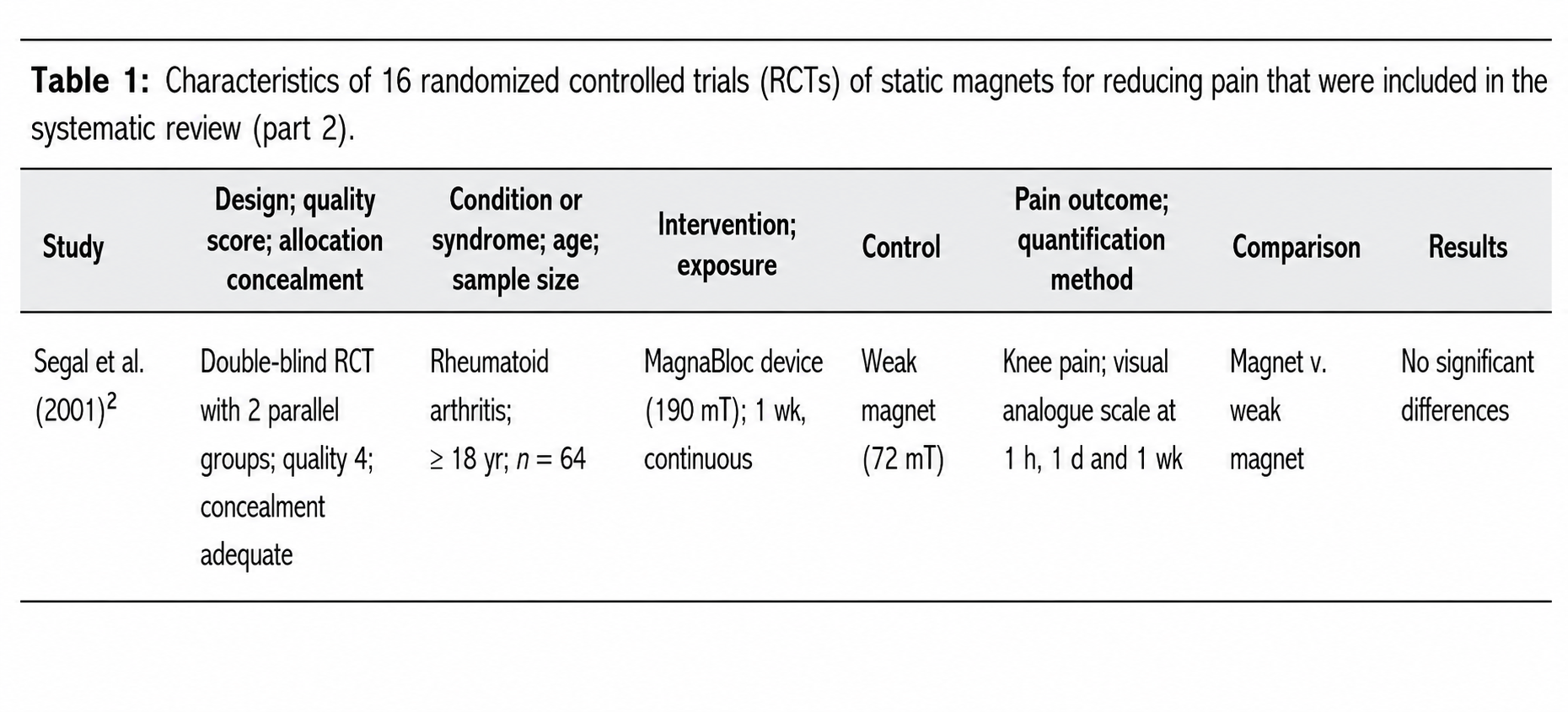
Pittler et al. (2007). “Static magnets for reducing pain: systematic review and meta-analysis of randomized trials.”
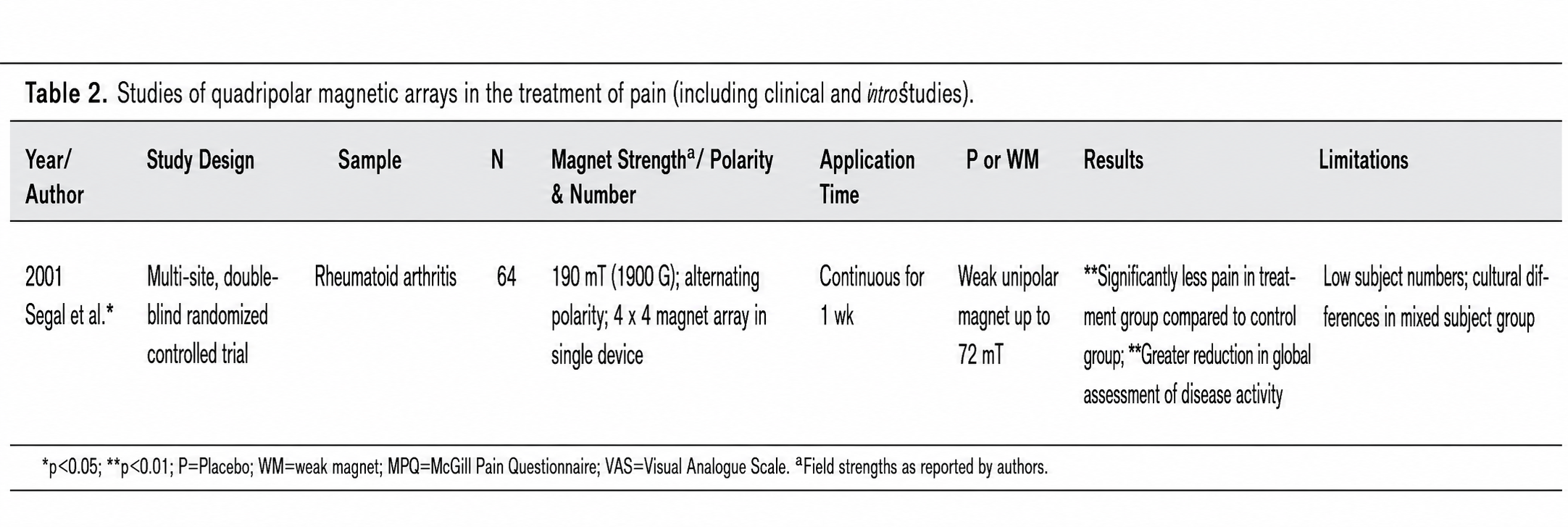
Laakso, L., F. Lutter, et al. (2009). “Static magnets – what are they and what do they do?”
Why “No Evidence” and “No Effect” Are Not the Same Thing
One of the most common misunderstandings in science is assuming that a study showing no measurable effect is equivalent to proving something cannot work.
In reality, many scientific studies investigate very specific conditions:
- A particular magnet design
- A specific field strength
- A defined placement protocol
- A fixed exposure duration
- A certain patient population
If those variables are poorly selected, the outcome may reveal little about the broader question being asked.
This is especially important in static magnetic field research because magnetic fields are highly localized and weaken rapidly with distance from the target tissue. Research involving weak bipolar magnets, poor placement, or insufficient exposure duration may not be evaluating the same conditions used by practitioners working with precision multipolar medical magnets.
Rather than asking:
“Do magnets work?”
A more scientifically useful question may be:
“Under what conditions might engineered static magnetic field gradients influence biological systems?”
This distinction is central to modern Field | Dose | Placement thinking.
Why Magnet Design and Field Conditions Matter
Evidence Exists, but Mechanisms Remain an Active Area of Investigation
A second misconception is that the absence of complete mechanistic certainty means there is no scientific evidence.
Science rarely works this way.
Many accepted therapies were used clinically before their mechanisms were fully understood.
In the case of static magnetic fields, laboratory studies have demonstrated measurable biological interactions under specific conditions.
Research involving steep static magnetic field gradients generated by quadrupolar magnetic arrays demonstrated reversible suppression of sustained sensory neuron firing under laboratory conditions. Investigators observed altered neuronal excitability and recovery of firing following removal of the magnetic field.
This does not prove that all magnets work for all conditions.
It does, however, demonstrate that static magnetic fields can interact with biological systems in ways that warrant ongoing investigation.
Modern discussions increasingly focus on concepts such as:
- Membrane excitability
- Resting membrane potential
- Sodium ion permeability
- Calcium ion regulation
- Sensitized nerve behavior
- Reversible neuromodulation
The proposed mechanisms are cautious and biologically plausible rather than simplistic claims about circulation or “healing energy.”
Why Field Gradients Have Become a Major Focus in Static Field Therapy
One of the most significant developments in magnetic field therapy research is the growing focus on magnetic field gradients.
A uniform magnetic field may behave very differently from a field that changes rapidly across space.
Multipolar medical magnets are designed to create localized gradient regions that generate spatial variation across tissues.
This concept has become increasingly important because biological structures are highly organized rather than uniform. Cells, membranes, ion channels, connective tissue, and nerve pathways may respond differently depending on how field gradients are distributed.
As a result, many researchers and practitioners have shifted attention away from simplistic questions about magnet strength alone and toward questions involving:
- Field geometry
- Gradient complexity
- Anatomical placement
- Exposure duration
- Target tissue depth
These concepts form the foundation of the Field | Dose | Placement framework used throughout modern Q Magnets education.
What the Research Debate Often Misses About Real-World Application
A common challenge in magnetic therapy research is that placement is frequently underappreciated.
Magnetic fields weaken rapidly with distance.
A magnet positioned a few centimeters away from the intended target may create a very different exposure environment compared to one placed directly over a relevant anatomical structure.
This helps explain why some studies report positive outcomes while others report minimal effects.
Field strength alone does not determine exposure.
Variables include:
- Tissue depth
- Magnet size
- Exposure duration
- Placement accuracy
- Field geometry
- Sensitization state of the tissue
Modern recovery science increasingly recognizes that nervous system behavior, sensitized nerves, and altered excitability may contribute significantly to persistent pain experiences. This has encouraged broader interest in field-based recovery technologies and static field therapy approaches.
The Difference Between Skepticism and Scientific Curiosity
“When viewed through the lens of Field | Dose | Placement, many ‘negative’ studies are not testing the same thing as Q Magnets.”
References
Laakso, L., F. Lutter, et al. (2009). “Static magnets – what are they and what do they do?” Brazilian Journal of Physiotherapy 13(1). doi.
Pittler, Max H. et al. (2007). “Static magnets for reducing pain: systematic review and meta-analysis of randomized trials.” Canadian Medical Association Journal 2007;177(7):736–42. PMID: 17893349; doi.
Segal, N. A., Y. Toda, et al. (2001). “Two configurations of static magnetic fields for treating rheumatoid arthritis of the knee: a double-blind clinical trial.” Arch Phys Med Rehabil 82(10): 1453–1460. PMID 11588753; doi.
Colbert, Agatha P., Markov, Marko S., et al. (2008). “Static Magnetic Field Therapy: Dosimetry Considerations.” J Altern Complement Med Jun;14(5):577–82. PMID: 18532897; doi.